


Hashimoto's thyroiditis and the gut-immune interface
Date
29 Apr 2026
Author/Presenter
Share
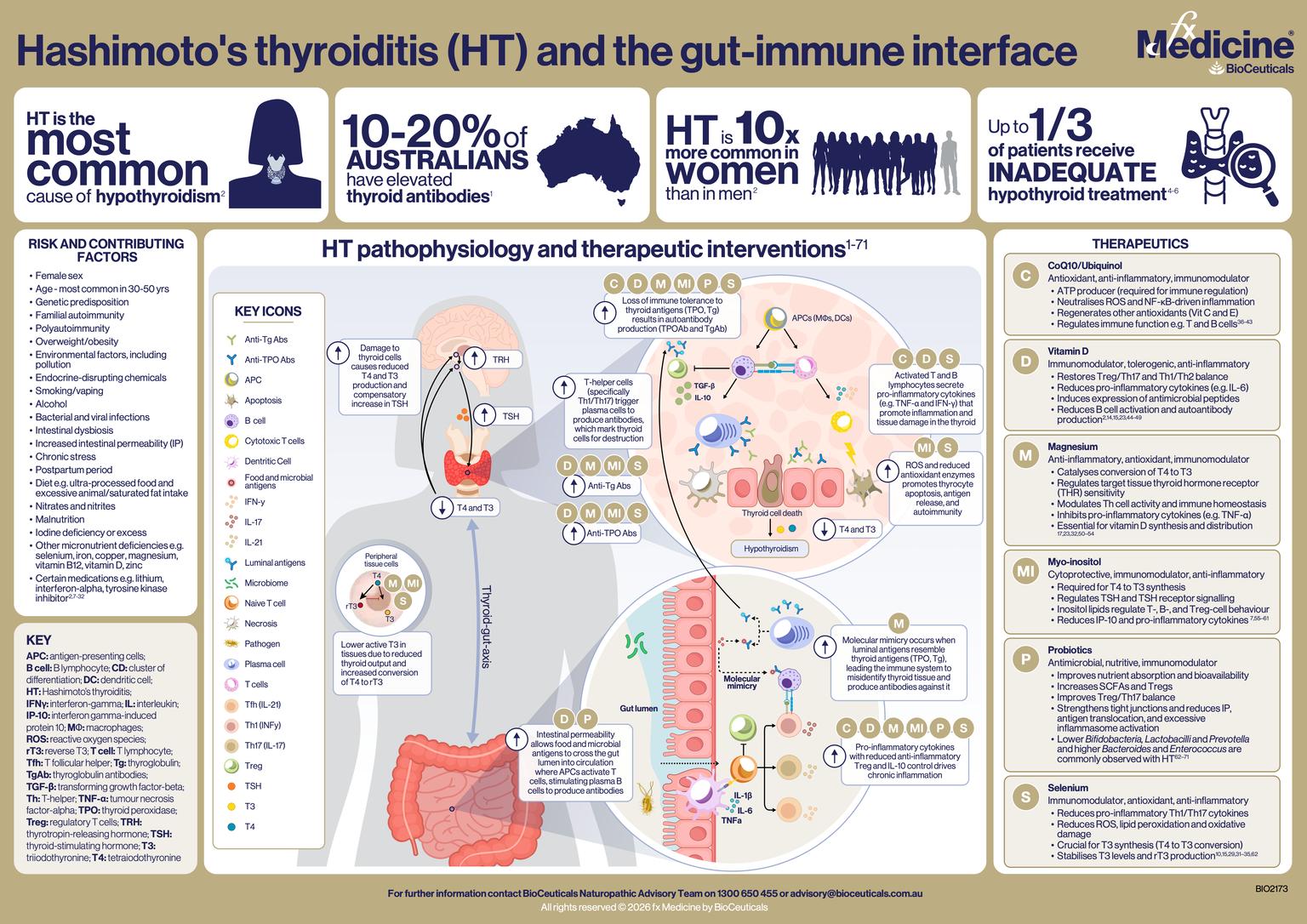
Hashimoto’s thyroiditis (HT) is the most common cause of hypothyroidism, characterised by immune-mediated destruction of thyroid tissue and disruption to thyroid hormone production. Central to this process is a loss of immune tolerance to thyroid antigens, including thyroid peroxidase (TPO) and thyroglobulin (Tg), leading to autoantibody production and chronic inflammation.
Activation of T-helper cells, particularly Th1 and Th17 pathways, promotes pro-inflammatory cytokine release and drives ongoing thyroid tissue damage. This is compounded by oxidative stress, reduced antioxidant capacity, and apoptosis of thyrocytes, further amplifying antigen presentation and immune activation.
The gut-immune interface plays a critical role in disease progression. Intestinal permeability allows luminal antigens to enter circulation, where molecular mimicry and immune activation contribute to cross-reactivity with thyroid tissue. Dysbiosis and reduced regulatory T cell (Treg) activity further perpetuate immune imbalance and systemic inflammation.
Conventional management typically focuses on thyroid hormone replacement; however, this may not fully address the underlying immune and inflammatory drivers in a significant proportion of patients.
Targeted nutritional and herbal strategies offer a complementary approach by supporting immune regulation, reducing oxidative stress, improving thyroid hormone metabolism, and restoring gut barrier integrity.
This infographic outlines the pathophysiology of Hashimoto’s thyroiditis and highlights key therapeutic interventions including selenium, vitamin D, magnesium, myo-inositol, probiotics, and CoQ10/ubiquinol, which support immune balance, antioxidant defence, and thyroid function.
References
1. Hughes K, Eastman C. Thyroid disease: Long-term management of hyperthyroidism and hypothyroidism. Aust J Gen Pract. 2021;50(1–2):36–42.
2. Aktaş HŞ. Vitamin B12 and Vitamin D Levels in Patients with Autoimmune Hypothyroidism and Their Correlation with Anti-Thyroid Peroxidase Antibodies. Med Princ Pract. 2020;29(4):364–70.
3. Daramjav N, Takagi J, Iwayama H, et al. Autoimmune Thyroiditis Shifting from Hashimoto’s Thyroiditis to Graves’ Disease. Medicina (Mex). 2023;59(4):757.
4. Chiovato L, Magri F, Carlé A. Hypothyroidism in Context: Where We’ve Been and Where We’re Going. Adv Ther. 2019;36(S2):47–58.
5. Lindgård Nielsen J, Karmisholt J, Bülow Pedersen I, et al. Prevalence and predictors of adequate treatment of overt hypothyroidism – a population-based study. EXCLI J 21Doc104 ISSN 1611-2156 [Internet]. 2022; Available from: https://www.excli.de/index.php/excli/article/view/4291
6. Keestra S, Högqvist Tabor V, Alvergne A. Reinterpreting patterns of variation in human thyroid function. Evol Med Public Health. 2021;9(1):93–112.
7. Paparo SR, Ferrari SM, Patrizio A, et al. Myoinositol in Autoimmune Thyroiditis. Front Endocrinol. 2022;13:930756.
8. Vargas-Uricoechea H, Castellanos-Pinedo A, Urrego-Noguera K, et al. A Scoping Review on the Prevalence of Hashimoto’s Thyroiditis and the Possible Associated Factors. Med Sci. 2025;13(2):43.
9. Rodrigues VG, Henrique G, Sousa-Vidal ÉK, et al. Thyroid under Attack: The Adverse Impact of Plasticizers, Pesticides, and PFASs on Thyroid Function. Endocrines. 2024;5(3):430–53.
10. Zhang H, Yang Y, Liu S, et al. Clinical efficacy of selenium supplementation in patients with Hashimoto thyroiditis: A systematic review and meta-analysis. Medicine (Baltimore). 2025;104(35):e44043.
11. Benites-Zapata VA, Ignacio-Cconchoy FL, Ulloque-Badaracco JR, et al. Vitamin B12 levels in thyroid disorders: A systematic review and meta-analysis. Front Endocrinol. 2023;14:1070592.
12. Botello A, Herrán M, Salcedo V, et al. Prevalence of latent and overt polyautoimmunity in autoimmune thyroid disease: A systematic review and meta‐analysis. Clin Endocrinol (Oxf). 2020;93(4):375–89.
13. Farebrother J, Zimmermann MB, Andersson M. Excess iodine intake: sources, assessment, and effects on thyroid function. Ann N Y Acad Sci. 2019;1446(1):44–65.
14. Galușca D, Popoviciu M, Babeș E, et al. Vitamin D Implications and Effect of Supplementation in Endocrine Disorders: Autoimmune Thyroid Disorders (Hashimoto’s Disease and Grave’s Disease), Diabetes Mellitus and Obesity. Medicina (Mex). 2022;58(2):194.
15. Hu S, Rayman MP. Multiple Nutritional Factors and the Risk of Hashimoto’s Thyroiditis. Thyroid. 2017;27(5):597–610.
16. Hu X, Chen Y, Shen Y, et al. Global prevalence and epidemiological trends of Hashimoto’s thyroiditis in adults: A systematic review and meta-analysis. Front Public Health. 2022;10:1020709.
17. Ihnatowicz P, Drywień M, Wątor P, et al. The importance of nutritional factors and dietary management of Hashimoto’s thyroiditis. Ann Agric Environ Med. 2020;27(2):184–93.
18. Khudair A, Khudair A, Niinuma SA, et al. Beyond thyroid dysfunction: the systemic impact of iodine excess. Front Endocrinol. 2025;16:1568807.
19. Lisco G, De Tullio A, Triggiani D, et al. Iodine Deficiency and Iodine Prophylaxis: An Overview and Update. Nutrients. 2023;15(4):1004.
20. Oliveira KJ, Chiamolera MI, Giannocco G, et al. Thyroid function disruptors: from nature to chemicals. J Mol Endocrinol. 2019;62(1):R1–19.
21. Osowiecka K, Myszkowska-Ryciak J. The Influence of Nutritional Intervention in the Treatment of Hashimoto’s Thyroiditis—A Systematic Review. Nutrients. 2023;15(4):1041.
22. Saint-André V, Charbit B, Biton A, et al. Smoking changes adaptive immunity with persistent effects. Nature. 2024;626(8000):827–35.
23. Shulhai AM, Rotondo R, Petraroli M, et al. The Role of Nutrition on Thyroid Function. Nutrients. 2024;16(15):2496.
24. Song R hua, Wang B, Yao Q ming, et al. The Impact of Obesity on Thyroid Autoimmunity and Dysfunction: A Systematic Review and Meta-Analysis. Front Immunol. 2019 Oct;10:2349.
25. Street ME, Shulhai AM, Petraroli M, et al. The impact of environmental factors and contaminants on thyroid function and disease from fetal to adult life: current evidence and future directions. Front Endocrinol. 2024;15:1429884.
26. Terracina S, Caronti B, Lucarelli M, et al. Alcohol Consumption and Autoimmune Diseases. Int J Mol Sci. 2025;26(2):845.
27. Tripathi P, Bhushan D, Banerjee A, et al. The Kaleidoscope of Polyautoimmunity: An Odyssey of Diagnostic Dilemmas. Cureus [Internet]. 2024; Available from: https://www.cureus.com/articles/211162-the-kaleidoscope-of-polyautoimmunity-an-odyssey-of-diagnostic-dilemmas
28. Valdés S, Doulatram-Gamgaram V, Maldonado-Araque C, et al. Ambient air pollution and thyroid function in Spanish adults. A nationwide population-based study ([email protected] study). Environ Health. 2022;21(1):76.
29. Wang YS, Liang SS, Ren JJ, et al. The Effects of Selenium Supplementation in the Treatment of Autoimmune Thyroiditis: An Overview of Systematic Reviews. Nutrients. 2023;15(14):3194.
30. Zhang M, Ni W, Zhang L, et al. Age-specific association between thyroid autoimmunity and hypothyroidism in Chinese adults aged over 65 years: a cross-sectional study. Front Endocrinol. 2023;14:1216308.
31. Zuo Y, Li Y, Gu X, et al. The correlation between selenium levels and autoimmune thyroid disease: a systematic review and meta-analysis. Ann Palliat Med. 2021;10(4):4398–408.
32. Kravchenko V, Zakharchenko T. Thyroid hormones and minerals in immunocorrection of disorders in autoimmune thyroid diseases. Front Endocrinol. 2023;14:1225494.
33. Ventura M, Melo M, Carrilho F. Selenium and Thyroid Disease: From Pathophysiology to Treatment. Int J Endocrinol. 2017;2017:1–9.
34. Hu Y, Feng W, Chen H, et al. Effect of selenium on thyroid autoimmunity and regulatory T cells in patients with Hashimoto’s thyroiditis: A prospective randomized‐controlled trial. Clin Transl Sci. 2021;14(4):1390–402.
35. Huwiler VV, Maissen-Abgottspon S, Stanga Z, et al. Selenium Supplementation in Patients with Hashimoto Thyroiditis: A Systematic Review and Meta-Analysis of Randomized Clinical Trials. Thyroid®. 2024;34(3):295–313.
36. Kudalkar S, Arya S, Pradhan M. Coenzyme Q10: A Comprehensive Review of Its Roles in Mitochondrial Health and Systemic Function. Int J Health Sci Res. 2025;15(9):106–15.
37. Aaseth J, Alexander J, Alehagen U. Coenzyme Q10 supplementation – In ageing and disease. Mech Ageing Dev. 2021;197:111521.
38. Alehagen U, Alexander J, Aaseth JO, et al. Supplementation with selenium and coenzyme Q10 in an elderly Swedish population low in selenium — positive effects on thyroid hormones, cardiovascular mortality, and quality of life. BMC Med. 2024;22(1):191.
39. Mancini A, Di Segni C, Raimondo S, et al. Thyroid Hormones, Oxidative Stress, and Inflammation. Mediators Inflamm. 2016;2016:1–12.
40. Mantle D, Hargreaves IP. Coenzyme Q10 and Autoimmune Disorders: An Overview. Int J Mol Sci. 2024;25(8):4576.
41. Mantle D, Hargreaves IP. Coenzyme Q10 and Endocrine Disorders: An Overview. Antioxidants. 2023;12(2):514.
42. Testai L, Martelli A, Flori L, et al. Coenzyme Q10: Clinical Applications beyond Cardiovascular Diseases. Nutrients. 2021;13(5):1697.
43. Mantle D, Heaton RA, Hargreaves IP. Coenzyme Q10 and Immune Function: An Overview. Antioxidants. 2021;10(5):759.
44. Tang J, Shan S, Li F, et al. Effects of vitamin D supplementation on autoantibodies and thyroid function in patients with Hashimoto’s thyroiditis: A systematic review and meta-analysis. Medicine (Baltimore). 2023;102(52):e36759.
45. Wang J, Lv S, Chen G, et al. Meta-Analysis of the Association between Vitamin D and Autoimmune Thyroid Disease. Nutrients. 2015;7(4):2485–98.
46. Yaqoob HAK, Haddad N, Alibrahim NTY. Evaluation of vitamin D status and its effectiveness among patients with Hashimoto’s thyroiditis in Basrah city of Iraq. Int J Adv Biochem Res. 2025;9(5):318–24.
47. Karakaya RE, Tam AA, Demir P, et al. Unveiling the Link Between Vitamin D, Hashimoto’s Thyroiditis, and Thyroid Functions: A Retrospective Study. Nutrients. 2025;17(9):1474.
48. Czarnywojtek A, Florek E, Pietrończyk K, et al. The Role of Vitamin D in Autoimmune Thyroid Diseases: A Narrative Review. J Clin Med. 2023;12(4):1452.
49. Miteva MZh, Nonchev BI, Orbetzova MM, et al. Vitamin D and Autoimmune Thyroid Diseases - a Review. Folia Med (Plovdiv). 2020;62(2):223–9.
50. Wang K, Wei H, Zhang W, et al. Severely low serum magnesium is associated with increased risks of positive anti-thyroglobulin antibody and hypothyroidism: A cross-sectional study. Sci Rep. 2018;8(1):9904.
51. Chaberska I, Feruś A, Lipska J, et al. The effect of multiple nutritional factors on hypothyroidism - a systemic review. Qual Sport. 2024;19:53782.
52. Mikulska AA, Karaźniewicz-Łada M, Filipowicz D, et al. Metabolic Characteristics of Hashimoto’s Thyroiditis Patients and the Role of Microelements and Diet in the Disease Management—An Overview. Int J Mol Sci. 2022;23(12):6580.
53. Cepeda V, Ródenas-Munar M, García S, et al. Unlocking the Power of Magnesium: A Systematic Review and Meta-Analysis Regarding Its Role in Oxidative Stress and Inflammation. Antioxidants. 2025;14(6):740.
54. Ashique S, Kumar S, Hussain A, et al. A narrative review on the role of magnesium in immune regulation, inflammation, infectious diseases, and cancer. J Health Popul Nutr. 2023;42(1):74.
55. Benvenga S, Nordio M, Laganà AS, et al. The Role of Inositol in Thyroid Physiology and in Subclinical Hypothyroidism Management. Front Endocrinol. 2021;12:662582.
56. Pace C, Tumino D, Russo M, et al. Role of selenium and myo-inositol supplementation on autoimmune thyroiditis progression. Endocr J. 2020;67(11):1093–8.
57. Peng B, Wang W, Gu Q, et al. Effects of different supplements on Hashimoto’s thyroiditis: a systematic review and network meta-analysis. Front Endocrinol. 2024 Dec;15:1445878.
58. Razavi SA, Kalari M, Haghzad T, et al. Exploring the potential of myo-inositol in thyroid disease management: focus on thyroid cancer diagnosis and therapy. Front Endocrinol. 2024;15:1418956.
59. Samuel CG, Singh P, Abdullahi H, et al. Unlocking the Therapeutic Potential: Selenium and Myo-Inositol Supplementation in Thyroid Disorders—Efficacy and Future Directions. Life. 2025;15(10):1500.
60. Fallahi P, Ferrari SM, Elia G, et al. Myo-inositol in autoimmune thyroiditis, and hypothyroidism. Rev Endocr Metab Disord. 2018;19(4):349–54.
61. Nordio M, Basciani S. Treatment with Myo-Inositol and Selenium Ensures Euthyroidism in Patients with Autoimmune Thyroiditis. Int J Endocrinol. 2017;2017:1–6.
62. Bano I, Hassan MF, Kieliszek M. A Comprehensive Review of Selenium as a Key Regulator in Thyroid Health. Biol Trace Elem Res. 2025;203(12):6466–80.
63. Alkader DAA, Asadi N, Solangi U, et al. Exploring the role of gut microbiota in autoimmune thyroid disorders: a systematic review and meta-analysis. Front Endocrinol. 2023;14:1238146.
64. Bargiel P, Szczuko M, Stachowska L, et al. Microbiome Metabolites and Thyroid Dysfunction. J Clin Med. 2021;10(16):3609.
65. Cayres LCDF, De Salis LVV, Rodrigues GSP, et al. Detection of Alterations in the Gut Microbiota and Intestinal Permeability in Patients With Hashimoto Thyroiditis. Front Immunol. 2021;12:579140.
66. Gong B, Wang C, Meng F, et al. Association Between Gut Microbiota and Autoimmune Thyroid Disease: A Systematic Review and Meta-Analysis. Front Endocrinol. 2021;12:774362.
67. Huo D, Cen C, Chang H, et al. Probiotic Bifidobacterium longum supplied with methimazole improved the thyroid function of Graves’ disease patients through the gut-thyroid axis. Commun Biol. 2021;4(1):1046.
68. Knezevic J, Starchl C, Tmava Berisha A, et al. Thyroid-Gut-Axis: How Does the Microbiota Influence Thyroid Function? Nutrients. 2020;12(6):1769.
69. Sawicka-Gutaj N, Gruszczyński D, Zawalna N, et al. Microbiota Alterations in Patients with Autoimmune Thyroid Diseases: A Systematic Review. Int J Mol Sci. 2022;23(21):13450.
70. Sessa L, Malavolta E, Sodero G, et al. The conspiring role of gut microbiota as primer of autoimmune thyroid diseases: A scoping focus. Autoimmun Rev. 2025;24(5):103780.
71. Yan K, Sun X, Fan C, et al. Unveiling the Role of Gut Microbiota and Metabolites in Autoimmune Thyroid Diseases: Emerging Perspectives. Int J Mol Sci. 2024;25(20):10918.